Wednesday, November 27, 2024

Solar-Pantheonism


After learning about my Proto-Indo-European and Norse ancestors (which I discuss here), combined with being influenced by the philosophy of Nietzsche and Dr. Paul Dobrnasky M.D. -- on the use of Greek Gods as archetypes of our biological instincts, which I disuss in my introductory post on my core thesis -- I realized that what all of this insight can be summed up as was an originating worldview template which I coined solar-pantheonism. 


I realized that nearly all the world's religions and mythologies can be traced back to this same or similar template of some kind of early form of Sun worship or  reverence for the Sun, with solar motifs; or the Sun and the sky representing the core imagery of many ancient religions, such as the illuminating Sky Father (for example see, Dyeus: The Indo-European Sky Father by ReligionforBreakfast). This early Sun motif is also in the Hebew Bible. Take the simple example of Moses encountering God and then his face shines as if he encountered the Sun, and the Sun's radiance transferred to his face. 


This solar motif was then often combined with some kind of Pantheon of Gods. This was true not only of my Proto-Indo-European ancestors, but also with the Egyptians, etc. Even Christianity, whose theologians often deny it too was based on this solar motif, is no doubt itself clearly based on a solar theology (also see here and here to see the obvious sunlight metaphors in the New Testament).


So solar spirituality is actually an anciently rooted originating mythology that ties together not only the Proto-Indo-Europeans but also Persian Zoroastrianism and the Old Testament Israelite religion, up to Christianity itself being based largely on a solar motif: with Christ being represented as akin to the shining Sun who causes others to shine.


Even thoough most Christian theologians claim to be purely monotheistic and they do not have a Pantheon; the late Protestant theologian Michael Heiser clearly showed in his biblical scholarship that original New Testament Christianity did have some kind of a Pantheon or a Divine Council of Gods. 


Even those Christians who reject a Pantheon/Council of Gods (with one unique Head God as Heiser explains), if one digs deeper they find that the early Christian theologians simply replaced a Pantheon of Gods (like Zeus and Thor or Odin), or the Divine Council of Gods, with instead praying to saints and turning the Gods in the biblical Divine Council into lesser angels (also see here). 


The Eastern Orthodox Church for example, has taken what Dr. Paul calls the gender instincts (which he teaches about through the archetypes of the Greek gods) and instead developed a way to represent the biological instincts through various Saints; for example, through military saints, in order to represent masculine courage in battle or dying martyrs with courage. A young male YouTuber at Church of the Eternal Logos, who is a member of Eastern Orthodoxy, also has videos on the Orthodox Saints as representations of a more muscular Christianity (that is reminiscent of the Greek Gods). Also see the Main Cathedral of the Russian Armed Forces (Cathedral of the Resurrection of Christ), which contains military imagery on the cathedral itself and is made from Green tanks (see short video here). 


Mormonism also has solar motifs in for example D&C 88: 6-13, and a very clear Pantheon or Council of Gods in Abraham chapter 4. The Book of Mormon is full of solar imagery as well with a tree of white lighted fruit representing Christ as a solar power (see images here and here); and a post-resurrection Christ visiting the American continant in 3 Nephi, to smile and shine upon people so that they too basically glow with a solar radiance. 


I believe a picture is worth a thousand words and so as a more visual thinker, I put together this image to illustrate solar-pantheonism in a nutshell: 
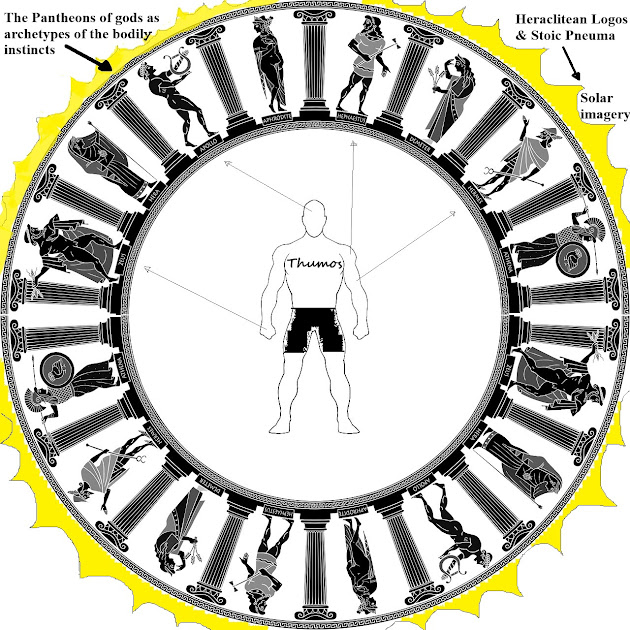


Image sources here & here


The male figure in the center represents the archetypal male hero. The lines from his body to the personages in the outer circle are meant to point to how the masculine instincts were represented by the various ancient pantheons of Gods. The multiple personages in the circle above are the Greek Gods (as seen here) which are meant as an example of this universal pantheon.

On the male figure's chest in the center I wrote thumos. According to Oxford Classical Dictionary:

Thymos (or thumos), cognate with Indo-European words meaning “smoke,” is one of a number of terms in Greek which associate psychological activity with air and breath. In the Homeric poems, thymos is one of a family of terms associated with internal psychological process of thought, emotion, volition, and motivation.


According to The Embodied Soul in Plato's Later Thought: Chapter 1 - Thymos (Published online by Cambridge University Press):


Thumos, often translated “spirit” or “spirited part”, acts as an intermediary between reason and appetite, imposing the dictates of reason on our irrational desires and pleasures. Yet the precise nature and function of the thumos is poorly understood ... Beginning from an analysis of the Homeric thumos...those who see the essence of thumos as lying in honour or self-esteem are mistaken, and that thumos represents a primitive drive for excellence or pre-eminence, with the desire for honour and recognition being merely derivative. …


The word and concept thumos matches Dr. Paul Dobransky's concept of passion as manifest through the archetypes of the gender instinctsSo what the ancient pantheons do is provide mythical expression of thumos through the masculine and feminine instincts as explained by Dr. Paul Dobransky M.D. 


The wikipedia article here on thumos, discusses Plato's three-part soul, which matches the popular metaphor of the Elephant and the Rider (or an Ant riding the Elaphant)Also see Got Thumos? by ArtofManliness.com.


On the upper right of the circle in my illustration above, I refer to the Heraclitean Logos. According to the Internet Encyclopedia of Philosophy on Heraclitus, we read:


A Greek philosopher of the late 6th century BCE, Heraclitus criticizes his predecessors and contemporaries for their failure to see the unity in experience. He claims to announce an everlasting Word (Logos) according to which all things are one, in some sense. Opposites are necessary for life, but they are unified in a system of balanced exchanges. The world itself consists of a law-like interchange of elements, symbolized by fire. Thus the world is not to be identified with any particular substance, but rather with an ongoing process governed by a law of change.


I also refer to the Stoic pneuma. You pronounce pneuma as "nooma." By Referencing the Heraclitean Logos and Stoic pneuma ("nooma"), I meant to convey early metaphysical ideas of a universal divine fluid energy (as a material substance), acting as a metaphor for the one energy in nature propelling a yin-yang dance (an interpolary dynamic process) or the evolutionary becoming of all things through material energy transforming form to form; which we understand today through all the sciences, from biology to physics. As Charles Darwin eloquenly puts it in, The Origin of Species:


Thus, from the war of nature, from famine and death, the most exalted object which we are capable of conceiving, namely, the production of the higher animals, directly follows. There is grandeur in this view of life, with its several powers, having been originally breathed into a few forms or into one; and that, whilst this planet has gone cycling on according to the fixed law of gravity, from so simple a beginning endless forms most beautiful and most wonderful have been, and are being, evolved.”

The Heraclitean-Stoic pneumatic Logos, also metaphorically captures the underlying Source Power of all things; that which "originally breathed into a few forms or into one" the evolutionary process; i.e. the Ground of Becoming. That which answers the question: why is there something (forms) rather than nothing (in the cosmos)?


This mysterious cosmic Ultimate Phenomena, which originated the Big Bang and is expanding our universe, is clearly a force of pro-transformation and Becoming. So I think this Ground of Becoming is that which is cosmically animating all humans towards heroic adventure and action; as well as moving us toward psychological integration and flourishing as a species through for example the Aristotelian golden mean (or middle way), or simply practicing "moderation in all things." Or the ideal of principles-centeredness in Covey's 7 Habits book.


The way I see it this "solar pill" (if you will) precedes the new idea of taking the "Christ pill," because the "solar pill" is for me about appreciating the solar radiance of the real Sun that we all experience regardless of race or creed. We all experience the Sun daily, universally, as a literally Life-giving source of energy through photosynthesis (which is real, and a good way to form a natural spirituality or reverence for nature)


 We who descend from Proto-Indo-Europeans, had ancestors who formed an ancient solar mythology that intertwined a mother earth and the Sun, with the Sun representing an early concept of "God." For example, see wikepedia on deyus, where the English word "God" can be traced back to the Proto-Indo-Europeans' concept of the daylight-sky god / father. Also see wikipedia on the word God and Sky's the Limit by Dr. Luke Gorton; as well as Socrates and the Shining Father by Donovan). One finds this same solar motif among the Egyptians (see here and here).


This ancient solar theology was then combined with many of the various divine pantheons; as the pantheons affirmed the bodily instincts -- which bodily drives evolved via earthly matter and photosynthesis -- so that I see one intertwining universal solar-pantheon that is found to some degree in nearly all the world's religions and mythologies. 


This universal set of solar and instinctual metaphors connect us to our body, to the earth and the cosmic cycles: from the light of day to our biological instincts, which are likely rooted  in the cultural memories of one's heroic ancestors, personified as gods and heroes. 


Even the perceived rising and falling of the Sun in the sky, acts as a metaphor of one's own falling (i.e. often failing before succeeding) and rising again to become more antifragile. So too, one's ancestral lineage is the genetic memory of those falling in death to give rise to genetic traits passed on to you in a great solar chain of belonging. 


This cohesive all-as-one-solar-pantheon, affirms the instincts of the body and our connection to the Sun and all of life on earth: as the Sun is the source of energy that provides photosynthesis and the growth of life. In other words, without the Sun there is no life. So that the "solar view" is a return to one's ecological and ancestral roots and the affirmation of the Universe, the Earth, and the Body, all at once. 


When one connects to something larger than themselves, in this case something scientifically real in feeling a connection with the radiant Sun, the earth, our body, and a respect for one's ancestors, they can't lose their "faith' or become a "disbeliever." For solar-pantheonism is a spirituality of the real: real sunlight, real bodily instincts, real ancestors embodied in your genetic DNA; real heroic ancestors whose memories became personified as gods and heroes. Thus it is based on real life. 


Solar-Pantheonism is also the ultimate life affirmation and elevation of self-esteem by being enlarged through one's connection to their genealogical line of heroic successes and ancestral tribal power; like powerful aspen trees sharing the same genetic roots while being nourished by the bright yellow Sun. Thus, its an interconnecting orientation in this world


Its also a good way of overcoming selfishness by seeing oneself rooted in one's family with the daylight sky father representing symbolically the way of showing respect and honor toward earthly fathers; and seeing the Sun as a metaphorical example of everlasting warmth and glowing generosity and abundance. As well as the Sun representing descending (or going down) as a metaphor for embracing a life of inevitable failures and mistakes but seeing that as an opportunity for rising again and embracing change and antifragile growth; that is, being willing to "fall down and get back up again," which is metaphorically represented by the setting and rising Sun. 


The pantheons of gods are also empowering as metaphors or archetypes, as they point to one's own heroic masculine potential or heroic divine motherly potential. Furthermore, one's ancestry giving rise to the ethnic myths in the various tribal gods in each pantheon (from the Israelite god Yahweh to the Norse god Thor), points toward the gods being personification of each tribes' cultural memory based on those in the tribe who acted out superior masculine and feminine instincts toward the survival and growth of the tribe. So that these heroic men and motherly women became personified as gods. 


Solar-Patheonism also fits with the Nietzschean option of envisioning  future Superhumans (future generations who embody the cultural memories of those today who are the most life-affirming and heroic among us, giving rise to future Beyond-humans). In other words, the Nietzschean vision of growing into future generations that don't turn their backs on the radiant Sun and earth beneath their feet -- who don't seek to escape their bodies and reject this world for an anti-body afterworld -- but who instead fully affirm earth and sky, the cycles of Nature, and their own real life and natural biology with all of it here and now deemed good and holy. 


So when I talk about solar-pantheonism, I'm not singling out only my Proto-Indo-European ancestors, but I am pointing to an ancient universal life-orienting mytho-psychology: based around the Sun, the cycles, seasons, and the bodily instincts, which is again nearly universal as the originating sources of nearly all the world's religions.


So what I am presenting here is not an ethnocentric perspective; yet I see nothing wrong with somebody connecting with their own ethnic religion, such as a Jewish person identifying more with Judaism as the ancestral religion of their ethnicity. For I find that solar-pantheonism can be found in nearly all religions. For example, an ethnic Egyptian will find the Egyptian gods representing the same solar energy within a similar pantheon of gods (representing the biological instincts). Same thing with the Greek and Norse religions with the same solar energy and similar pantheons. 


This is true I think of nearly all ancient religions, from the Greeks to the Egyptians to Germans and Scandinavians; with each ethnic culture developing a unique set of gods in their pantheon, that are depicted with specific cultural traits based on the cultural memory of each tribe. So for example, in my ancestor's Norse religion, the God Thor had a hammer (based on their specific ancient Scandinavian culture), while the Hindu God Indra has the vajra. This does not make one's ethnic tribes' pantheon of gods superior to any other, as I see them all as mythological representations of the masculine and feminine biological instincts (as I explained in my introduction).


So to be clear, I'm not advocating any type of racist ideology or ethnocentrism, but each individual connecting either through their own ethnic religion (like a Jew for Judaism), or also through another's ethnic religion, like a Scandinavian becoming a Christian or Hindu, or Egyptian, or whatever, it doesn't really matter to me. For, as I see it, there is one original solar energy within each mythos and the same universal biological instincts personified in the various pantheons of gods. 


So you basically have one universal life-affirming mythos (i.e. one biology affirming mythos), within solar-pantheonism: with a real Sun above our head being a constant reminder of an abundance of energy; energy, which according to science, can neither be created nor destroyed; and the Sun as a radiating ball of warmth and light acting as a spiritual metaphor we can emulate in our own lives by being an overflowing body of positive energy and brightness. This universal, natural theology, I think can unite us all around the shared values of life itself; combined with our evolved competitive instincts, which drive evolution and affirms our biological bodies toward a future of new forms "most beautiful and most wonderful," that are continuously being evolved overtime as a good and holy process of growth and becoming.


What this means for me as someone of Germanic and Scandinavian decent, is that I now more fully realize, after doing this research, that I am in a real way larger than my mere self (my conscious identity). I am the combined cultural memory of all my ancestors that is encoded in my DNA! As Whitman wrote, "I am large, I contain multitudes." Or to use a Carl Sagan term, I am combined "metamind." I am being lived out by my genetic aspen-like roots and my cultural heritage; for example, my very body and physiological traits, my more pale skin and blonde hair and blue eyes, to my strength and larger height and stature, is all a product of my Germanic Norse ancestry; and part of that biological makeup is a product of culture, which is rooted in an ancient Proto-Indo-European "spirituality," which branched out into various solar pantheons, from the Norse to the Celtic, all the way to the Vedic pantheon of the Hindus. 


So as I see it, just as I am being lived by evolutionary adaptations within my biological system, I am also being lived by my ancestral cultural heritage. So I am indeed large, as part of a grand genetic and cultural heritage rooted in my DNA: a lived metabody of heroic horse riding and adventurous seafaring peoples and family-oriented tribally unified peoples;  projecting their instincts onto the gods as archetypes of their collective tribal memories; and passing on their genes literally into me genetically.


 I am thus a large body of genetic and cultural memories, being lived out on an unconscious level beneath the surface of my conscious awareness; from the very language I speak (English, which is a Proto-Indo-European language), to the meaning of many English words which are rooted in my Norse ancestry and their mythology. Thus I am part of a great connecting chain of genetic and cultural power and vitality as a solar powered body of heroic potentiality.


Tuesday, November 26, 2024

Syncretic Indo-European Faith by Zachary Gill: Excerpts & Commentary on the Introduction and his defining "Pagan"


On page 6, Gill talks about how those in charge of technology and media, etc., 

strip away your independence, your personality, and your spirituality, threatening to take away all the things that make you human. All the things that make you Folk. Communication and spirituality have always been the thing that creates viable communities, and they seek to destroy that. ... Traditional spirituality, family values, and proper virtues of manhood and womanhood are returning. And it isn’t through Abrahamic religions nor is it through defiance of modern society. Instead, it is through the momentum of Folk religions and Indo-European spirituality, where it could be said that Christianity got its values to begin with. 


Then on page 9 he writes:


First Statement of Awakening (Taking the Sunpill)


So, I have this deep gut feeling, that with the Vedas, the Eddas, the Gathas, and Rodnovery/Romuva faiths, the key to where the real original religion for the Indo-European can be found. ...


I like how he says, "Taking the Sunpill" as a play on the Redpill and all the other blank-pill terms to describe a worldview or philosphy. This Indo-European spirituality based around the early ancient people's recognition of the Sun in their formation of a spirituality, could also be called what I have coined Solar-Pantheonism. 


He goes onto talk about rather than finding meaning in life or direction through media messages, greed, hedonism, or new age religions or gurus, one can simply form meaning and spirituality through their own ancestry:


The truth is there before us, within our ancestral blood, within our forefathers, within our children, and ever-present in the Cosmos.


This resonated with me as I read this, for I have been contemplating this idea before even reading this book, on why growing up was I never taught anything about the Norse religion of my Scandinavian ancestors. Why have I only been taught another culture's religion, as the Bible is not a cultural history of my ancestors but somebody else's.


I spent years struggling with trying to force myself to believe in the Mormon theology; and then the Protestant theology, which was always forcing me to believe in ideas contrary to Nature, to the Cosmos. So this excerpt above that the truth is ever-present in the Cosmos resonates with me. I don't have to believe in something hard to believe but can experience real Sun rays on my skin for example, and I can notice the cycles of nature which are real, and the gods are real archetypes based in part on our gender instincts as I explain in my introduction.


 So Solar-Pantheonism is based on the reality I experience evidentially. In that it is not a mere "belief system," but real to me as it is based in my own genetic coding and genealogy, i.e. its the Folk religion of my forefathers. This universal Solar-Pantheon was formed by my ancestry while interacting with the real world; as they aristically formed Germanic and Norse gods and stories as manifestation of real masculine and feminine instincts; which was based in part on the heroic deeds and adventures of my own actual ancestors and their cultural history in the Eddas, etc. 


On page 10 he makes a good point that you're not allowed to question things in today's culture and if you do you're immediately labeled negatively. I agree when he says: "I’m pretty tired of labels. Always question anything that threatens you and yours no matter who you are. Always question what doesn’t flow with the natural laws. Always suspect what makes you weaker and doesn’t lead towards greatness or enlightenment." 


On page 11 he writes, "It is our hope that this book inspires those of Indo-European cultural background or Heritage/Ancestry to view society, spirituality, and culture through a healthier lens." Since I am myself of Indo-European cultural background or Heritage/Ancestry, I am interested in his perspective. 


In the section What is Indo-European Paganism?, he begins with, "Language, Genetics, Spirituality," then writes on page 14:


 Many will say that the term Indo-European only applies to a language tree and not to specific groups of people. ... Indo-Europeans brought their language, culture, and religion to the regions they migrated into. These traditions and concepts of faith were disseminated throughout the various areas that were settled, either through marriage or conquest or both.  For the sake of brevity when referring to Indo-Europeans, we will mean “of or relating to” the collective people and cultures of Europe and Western Asia, including the northernmost regions of India, with a primary focus on their religious traditions. 


Various spiritual, ethnic, and religious groups are included in the Indo-European Paganism. Examples of these groups are Vedic, Germanic, Norse, Hellenic, Hittite, Persian, Greeks, and Slavic religions.  Many scholars have compared and contrasted these religions and found similar themes, rituals, symbolism, and linguistic origins. In some cases, whole pantheons and views of theology are distinctly similar. Scholars have worked to, for lack of better words, reverse engineer, reconstruct, and reassemble the Proto-Indo-European (PIE) mythology.


 Gill then asks, "What Is a Pagan?" Writing on pages 15-16:


Many people today seem to identify as “pagan.” This word has developed into a sort of catch-all for anyone not part of the mainstream religious movement. It has also come to represent  “unsavory” individuals that Abrahamic religions do not approve of—especially those who have chosen to live their lives and their spirituality outside of the accepted norms. The word “pagan” no longer means what it used to. So, here is a clear definition of what the word ‘Pagan’ means.

Initially, the word ethnikos was used in the Bible when referring to pagans. Ethnikos, meaning those of the ethnic faith. The word gentile, which was used frequently in the Bible, referred to non-Jewish or a Christian who isn’t Jewish but also isn’t pagan. However, this word also began to take on a meaning similar to “pagan.” Gentile, from Latin gentilis “of or belonging to the same people or nation,” from gēns ‘clan; Tribe; people, family’ is similar to the root word we use for Genes, which would imply Folk or family.

 The word “pagan” is derived from the Latin pāgānus, meaning ‘rural or rustic,’ but was later used to refer to civilians vs. the ruling class. 

Around 400 AD, Pagan being used as Not-Christian started to come about through the use of Vulgar Latin. ...


After going into an analysis of ancient languages he concludes:


This would imply that “Pagan” means the people of Indo-European faiths or people of the European rural faiths. Many people who claim the umbrella term “Pagan” are not adequately following the Indo-European folk/family traditions or morals as they should. They are not pagan. Paganism will always be centered around Folk and family and the worship of the Gods.


Monday, November 18, 2024

Proto-Indo-Europeans


I highly recommend this article to begin with: Who Were the Indo-Europeans and Why Does It Matter? by Daniel McCoy. This short article is a good introduction to understanding the Proto-Indo-Europeans from whom arose the various Indo-European peoples and why it matters to know this. 


Those of us of Germanic and/or Scandinavian descent share a common ancestry with other peoples and their languages. According to Proto-Indo-European Language Tree: Origin, Map & Examples by study.com:


Proto-Indo-European language was a language likely spoken about 4,500 years ago (and before) in what is now Southern Russia and Ukraine. ... The existing Indo-European languages, such as English, Spanish, or Hindi, descend from this language. ... Most languages of the world can be combined into one of many language families. Language families are groups of languages that all descend from a common ancestor. Indo-European is the largest language family on Earth, encompassing languages spoken by about 3.2 billion people, or 42% of the world's population. ... the theory that the Proto-Indo-European language origin from a region directly north of the Black Sea, in what is now the Ukraine and Southern Russia, north of the Caucasus. The cultures associated with the language were Yamna and Kurgan, which existed until about 2500 BCE. This theory is widely accepted by a large majority of scholars. ... Evidence for the Indo-European language origin comes not only from linguistics but also from archeology and cultural anthropology. For instance, the same gods appear both in Lithuanian and ancient Hindu mythology (e.g., twin horsemen gods called Ashvieniai in Lithuanian and Ashvini in Sanskrit). Additionally, the worship of a sky god (Zeus, Jupiter, Odin) seems to be a common trait in many Indo-European cultures. Images of this sky god are known from the material remains of Greek and Roman civilization as well as various myths. ... Today, approximately 3 billion people around the world speak a variation of this Indo-European mother tongue. English is one of these, but they include diverse languages such as Russian, French, Greek, Hindi, and Persian. ...

 ... linguistic archaeologists, such as David Anthony, believe the first speakers of the Indo-European mother tongue were chariot-driving, warlike pastoralists who migrated out of their homeland on the Black Sea steppe (one of the vast treeless tracts in southeastern Europe or Asia) about 4,000 years ago, ultimately conquering Europe and Asia, and bringing their language with them.


A video on the site above goes on to explain that the Proto-Indo-European language would have been unrelated to other world languages such as Chinese, Polynesian and Hebrew. Thus one can see that the Indo-Europeans can be traced back through the study of languages to one common ancestry.


Here are images of the Indo-European language-families:


(Source: Click to enlarge image)


(Source: Click to enlarge image)

Also see this article: Study of Indo-European Languages Origin Reconciles Two Dominant Hypotheses by guest (December 21, 2024), which concludes by stating:

... Regarding the question of the origin of Indo-European languages, calculations based on the new data show that they were first spoken approximately 8,000 years ago.
The results of this research do not line up neatly with either the Anatolian or the Kurgan hypotheses. Instead they suggest that the birthplace of Indo-European languages is somewhere in the south of the Caucasus region. From there, they then expanded in various directions: westward towards Greece and Albania; eastward towards India, and northward towards the Pontic Steppe.
Around three millennia later there was then a second wave of expansion from the Pontic Steppe towards Europe, which gave rise to the majority of the languages that are spoken today in Europe. This hybrid hypothesis, which marries up the two previously established theories, also aligns with the results of the most recent studies in the field of genetic anthropology.


Again, I highly recommend this article Who Were the Indo-Europeans and Why Does It Matter? by Daniel McCoy. After giving a brief summary of the Proto-Indo-Europeans, McCoy goes on to write:


 With regard to the second question – why is the study of the Indo-Europeans relevant to our lives today? – I would give two answers.

The first is that the world wouldn’t be what it is today had it not been for the Indo-Europeans. If you’re reading this article, chances are that your first language is an Indo-European language, and it’s also very likely that all of the languages you speak are Indo-European languages. Given how powerfully language shapes the range of thoughts available for us to think, this fact exerts no small influence on our outlook on life and therefore, by extension, on our actions. Vestiges of the tri-functional hierarchy are still present in our societies; at least in theory, governments have more power than the police and military, who in turn have more power than the rest of the “civilian” population.

More specific examples could also be readily furnished. For example, Christianity couldn’t have existed without the Persian prophet Zoroaster/Zarathustra first articulating the idea of a dualistic, moral good and evil, and even though Zoroaster’s philosophy and religion, Zoroastrianism, was in many respects a radical departure from earlier Indo-European thinking, he nevertheless used his Indo-European heritage as so many building blocks from which to craft his own vision.[7]

My second answer to the question of why Indo-European studies is relevant is that, as powerfully as it’s influenced our modern social structure and thought, there are also many ways in which the Indo-European worldview is strikingly different from our own. Studying it enables you to have that many more perspectives to draw from in creating your own worldview.

For further reading on the Proto-Indo-Europeans, see:


Also see this article Landmark studies track source of Indo-European languages spoken by 40% of world on the origin of the ethnolinguistic Indo-European language being traced back genetically to the Caucasus Lower Volga People. The article states, "What is now clear is that a population of Caucasus Lower Volga people moved west and started mixing with locals, thereby forming the distinct Yamnaya genome. ... Language isn’t the only tradition the Yamnaya carried on from their Caucasus Lower Volga forebears. Both cultures buried their dead in kurgans, or large tombs with earth mounded on top. ..."

Also, see these interesting videos by Stephen's History of the World YouTube Channel:


These videos do a good job tracing the origins of the language, mythos, and society of the Proto-Indo-Europeans; and how many religions descend from one original religious mythos (which I call Solar-Pantheonism) . 

Monday, November 11, 2024

Introductory Explanation for Why This Blog & My Core Thesis (or Position)


The origin of this blog was inspired in part by Nietzsche referring to himself and his philosophy as a Northwind. For more details see my google document here where I provide excerpts from the 2012 research paper Nietzsche and the North by Filip Lucian, that covers how Nietzsche was seeking to revitalize the ancient vitality of the Indo-Europeans and their heroic physiological natures and life-affirming mythos.


I am ancestrally from the North, i.e. I am Indo-European of Nordic or Scandinavian ancestry, being mostly Swedish. I wanted to appreciate my Nordic and/or Indo-European ancestors.


 I see many similarities in the mythological energy and utility of Greek mythology and Norse mythology because both are at their core what I call solar-pantheons. For example, this video, by a YouTuber begins by saying that 


[Anceient] Greek and old Norse religion...although separated by about 1,500 years ... I would not exactly call them two separate religions. They were far more similar than they were different and they both have the same Indo-European roots; if we go back far enough to proto-European times, 7, 8, thousand years ago, we were all one and the same. But by the time the Greek and North peoples migrated and evolved they developed two separate belief systems. 


So the North wind energy is a reference to the Nordic "Hyperborean spirit" of vitality that descends from the common ancestors of the Norse, Celts, Greeks and "Indian/Hindu"peoples, etc., who are known as the Proto-Indo-Europeans. So what we find is that this ancestral cultural energy or Northwind has been funneled through the physiologies and mythologies of the Indo-European ethnolinguistic branching ancestral family groups, from the Norse to Greeks to Hindus. For these groups are all basically the same in spiritual energy and vitality as they descend from the same ethnolinguistic and mythological source (the Proto-Indo-Europeans). For we can trace them all back to the same Proto-Indo-Europeans and a likely original Proto-Indo-European mythology from which all these groups grew separate based on environment yet retain similar ethnolinguistic mythologies. 


Note as well that according to this university page:

Seen genetically, Indo-European heritage encompasses all peoples of Germanic or Scandinavian or southern Mediterranean or Persian or Russian or northern Indian descent, any of a wide range of national groups stemming from India to Iceland.


The Proto-Indo-Europeans basically branched out into different groups and mythologies, from the Scandinavians with their Norse mythology to the  Hindu mythology in India. 


One reason for this blog is to honor and respect my own Germanic and Scandinavian (Swedish) ancestry and heritage as an American. For it was my ancestrally Germanic and Norse grandfathers and grandmothers, their unique lives and creativity, which formed the Norse mythology. So by appreciating and respecting their mythology I am connecting with my genetic roots and my ancestors as an American. 

The second reason is like unto the first. I realized that every ancient people produced a cultural mythos from their own life experiences and pre-conscious psychology and physiology as a people and culture; much like seeds and soil producing a particular kind of plant that's either healthy or unhealthy. So that from out of my Scandinavian ancestry their grew up from cultural memory a vitally alive mythology of gods and monsters, great heroes and deadly adventures. This mythical storytelling energy has inspired recent movies and TV series like Conan the Barbarian, The Lord of the Rings, Game of Thrones, and the 2013 series Vikings, etc. 


On Heathenry & Racial Ideologies 


To avoid any confusion, I want to be clear up front in this introduction that I don't identify as a "heathen" like some others refer to themselves. I am not a practitioner of Heathenry. Unfortunately, I have to make this crystal clear. For having mentioned my desire to respect and revere my Indo-European Scandinavian ancestry, I need to separate myself and distance myself from various fraternal organizations attempting to return to the literal worship of Thor and Odin. Many of these types of groups (note: no, not all of them) often unfortunately practice controversial ideas regarding race. In this regard, to be clear I am not in any way interested in any kind of racist ideology. 


My views are somewhat similar to Nietzsche's vision of future Superhumans. This was Nietzche's vision of the ideal next stage in human evolution: which he believed could be accomplished through any mix of races or ethnicities, and not just one so-called "superior race" (ethnically speaking). In other words, the natural process of evolution throughout thousands of years has mixes traits from various human genomes toward growing new, healthy, functionally successful and thriving organic forms of hominids. I do not believe in any version of "white supremacy." Instead, similar to Nietzsche, I believe in the growth of a healthy future humanity and even potentially a future hominid species evolving beyond humans in the next stage of evolution. 


I don't completely agree with everything Nietzsche wrote but I find his vision of focusing on the future by envisioning the best version of a healthy future humanity in contrast to his hypothetical Last Man an interesting thought experiment. I find his hypothetical concept of a future post-human hominid species (which he called the Overman or the Superhumans, meaning those that culturally and/or "spiritually" evolve beyond-mankind, over mankind, over the bridge of speciation) an interesting thought experiment on the trajectory that human hominid life can take in either growing toward a great health or a degenerate decline. Thus, I see his idea as a kind of theism, a theistic humanism where the Divine is the Heroic, and the good is the rank ordered lifeward successes. Thus, it's be an interesting psychological method for grounding our "spiritual" need to hold up an ideal (to live up to and revere) in the form of a future god-like future form of humanity at its highest and healthiest form imaginable.


 This Nietzchean view can even be treated as a healthy alternative form of belief, as a naturalized kind of God-belief. In that instead of projecting into the sky an invisible, inaudible god we can't prove exists -- the god of the sectarian Christian Creeds: a god without bodily parts or passions, which Thomas Jefferson said such "immaterial existences is to talk of nothings" -- Nietzsche instead offered a practical way of grounding our "spiritualimpulses in the real world of biological evolution and our human potential for greatness or decline; by envisioning a possible future god-like human species we could evolve towards over time. So that the future Superhumans could replace current "god beliefs" with instead the concept of the Superhumans as a more realistic ideal: in that we could in fact evolve toward the Superhumans both culturally and in biological reality rather than culturally devolving into what Nietzche called the Last Man


From this bio-realist Nietzchean perspective, any ethnicity can come together and intermix with others, with the most healthy among each ancestry producing the next stage in human evolution in a natural and organic process. 


This type of "Nietzscheanish spirituality" I am discussing has nothing to do with eugenics or racist ideologies, but is simply about each individual person living their most life-affirming and healthiest life possible, like a man living his most heroic and noble life possible as a free spirit; and procreating with women of any race or ethnicity he chooses, who will provide him with healthy offspring. In other words, what I am talking about has nothing to do with racism or eugenics or any such thing.   


Solar Pantheonism 


I coined the term solar-pantheonism to refer to a universal spiritual philosophy found in nearly all ethnic religions, from African pantheons to the Aztec pantheon (which is the ancient indigenous religion of many Spanish speakers). A good example of seeing how there are various indigenous religious gods as a product of each ethnic people, see this clip Hall of the Gods, from the television series American Gods, Season 2. This clip illustrates how each of the gods has a clear and obvious cultural and ethnic component based on a particular people and their lives which is projected onto the formation of their gods.


The word solar refers to the Sun which is a common source of inspiration in most religious mythologies; even in Christianity which is also solar religion. In her article, Constantine's Conversion to Christianity, Rebecca Denova writes:


During the reign of Emperor Aurelian (r. 270-275 CE) the cult of Sol Invictus ("the invincible, unconquered sun") was promoted as his [Constantine's] family cult. This cult also embodied concepts of Jupiter, Apollo, and Helios. Sol Invictus merged with another popular military cult, that of Mithras. At the same time, Aurelian also reorganized imperial finances and regulated imports and the price of food throughout the provinces. His ideals may be summarized as "one god, one empire". Constantius and his son Constantine were both members of the cult of Sol Invictus. ... 
... The Arch of Constantine (erected in 315 CE near the Colosseum) lacks Christian symbols and contains sculptures of offerings to Apollo, Diana, and Hercules.
... Constantine issued coins with himself in the figure of Sol Invictus and Helios. ... 


... While native cults and traditions remained, Constantine favored Christians both financially and theologically. As their supreme patron, Constantine endowed Christians with funds to build their basilicas and to acquire property, returned confiscated property, named Christians to high-ranking offices, and exempted Christian clergy from taxes. In theological support, his position as head of the Church as well as the empire contributed to imperial dictates that promoted Christian unity of belief.


In the article Sol Invictus: The pagan Sun god that helped Christianity conquer the Roman Empire, we learn that:

historians argue [that]...Sol Invictus, a ... Sun god whose role in Roman society was eventually supplanted by Jesus Christ .... Rome’s transition from polytheism to monotheism isn’t about Christianity replacing the cult of Sol Invictus so much as it is about non-Christian Romans accepting Christ as the replacement for the Sun god." 


Why do you think that the Christ figure in the New Testament is referred to as the light of the world that shines in darkness? See John 1:5; 8:12.

Greco-Nordic Americanism


As of early in the year 2025, I call myself a Greco - Nordic - Possibilian and a Deistin order to describe my current spiritual worldview or philosophical life-stance. By "Greco" I am referencing Dr. Paul's Dobransky's Instincts Psychology and his use of Greek mythology to promote healthy masculine and feminine instincts. By "Nordic" I am referring to both my ancestor's Norse (or Viking) mythology which was life-affirming (despite its sometimes barbarity by modern ethical standards), as well today's modern Scandinavian Nature-based spirituality and the Nordic formation of a kind of Secular Christianity; which to me proves that a People do not need to be a scripture-reading religious culture to be civil or good/ethical. A longer version to describe my current worldview would be something like: I'm a Greco - Nordic - Stoic - Deist, Epicurean - Nietzscheanish - Possibilian.

I realize now that if one simply pulls out a Dollar Bill they have an entire philosophy of life right there with the symbols on the back of the dollar bill: representing the American Deism of Thomas Jefferson and Ben Franklin (which I cover on this site). Besides Deism, Epicureanism, and Stoicism, I found that Possibilianism freed me from the internal psychological demand for certainty about the afterlife (or possible afterlives).

Norse and Greek Gods as Metaphorical Archetypes of our Pre-Conscious Instincts & The Heroic Ideal 


This heroic adventurism in Norse mythology is connected to my genetic roots, as the myths and stories are intertwined with my own ancestral memory as a people and culture. The Norse gods and sagas were forged from the actual experiences of my very own ancestors which were molded with artistic creativity into tales of elves and giants, dragons and wolves, Thor's hammer and Odin's spear. For example see the  video, Sources on the Norse Gods as REAL Living Humans by Norse Magic and Beliefs YouTube Channel. At the start of the video the author explains that for him the Norse gods are only symbolic: representing aspects of nature, our Universe, and parts of our own body and psyche. He then goes on to say that it's possible that the Norse gods and myths are not only metaphorical, but also, to paraphrase him, they could also be exaggerations as mythologized legends based on real humans and their heroic status and valorous accomplishments. I agree with this assessment.


So to clarify upfront, I am not in any way attempting to return to a literal practice of the worship of pagan gods. I have seen some people on YouTube literally offering forms of sacrifice to gods like Thor and Odin. I personally think this is silly and superstitious, but to each their own. So I do not consider myself a "pagan" because that is a loaded term which can include superstitious practices. If anything I would be promoting secular or naturalistic "paganism."But even there I still cringe at the term "paganism" even with the term secular in front of it, because I often think of New Age woo nonsense and pagan Wicca, all of which I completely reject for many reasons. 


Another term I've seen thrown around is European Paganism, like on The Ark (Heroic Ideal) YouTube Channel, which is probably closer to what I would find value in. In other words, I'm not promoting a literal belief in pagan gods or returning to pagan sacrifices! I am instead seeking to revitalize the pro-instincts psychology of the heroic ideal embedded within the Norse and Greek mythologies.


I think a better way to describe what I find value in is not "paganism," which again has supernatural connotations; but what I would maybe call Heroic Instinctualism. 


The Frankfurt Inscription (a German Cross Amulet from 200s AD)

 According to this article by Tim Newcomb:   An 1,800-year-old silver amulet discovered buried in a Frankfurt, Germany grave, still next to...